
A telechelic silicone diacrylate is a polydimethylsiloxane (PDMS) chain that carries one reactive acrylate group on each end. The prefix telechelic comes from Greek, meaning “end” — and that is exactly the point. Both chain ends are capped with an acrylate group, making this molecule fundamentally different from single-end or non-functional silicones.
Because both ends can react, the siloxane backbone becomes a building block for chain extension, crosslinked networks, and ABA triblock copolymers. A broader map of functional silicones is available in the reactive silicone oil guide.
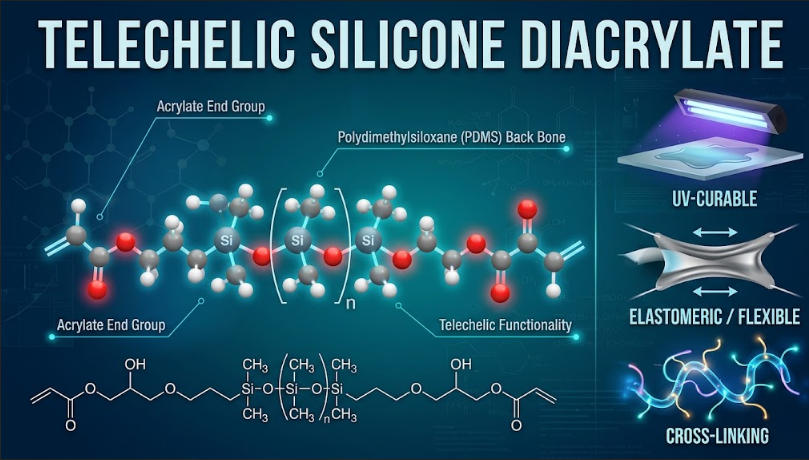
What Both-End Functionality Enables
Two reactive ends unlock three outcomes that single-end systems cannot achieve:
- Chain extension — each molecule connects two growing chains
- Crosslinked networks — the difunctional backbone bridges chains into a 3D mesh
- ABA triblock copolymers — the silicone acts as the soft B block between two harder A blocks
The table below shows how functionality controls the final product topology:
| Functionality | End-Group Distribution | Cured Product | Typical Use |
|---|---|---|---|
| Monofunctional | Single acrylate end | Linear graft side chain | Surface modification |
| Difunctional / Telechelic | Both ends reactive | Network / ABA triblock | Release coatings, 3D printing |
| Non-functional | No reactive end | Inert silicone fluid | Lubrication, demolding |
To compare how end groups build crosslink density, review our reactive silicone crosslinkers overview.
Monofunctional vs. Telechelic: Grafts vs. Networks
A monofunctional PDMS has only one reactive end. It attaches to a backbone and hangs as a side chain, but it cannot bridge two chains together. As a result, it modifies surfaces rather than forming networks.
A telechelic silicone diacrylate behaves entirely differently. With acrylate groups on both ends, each molecule connects to two separate chain segments at once. This is the structural reason why two-end functionality produces networks and ABA blocks, while single-end functionality only grafts.
For the broader silane building blocks that complement silicone chemistry, browse our silane products.
Molecular Weight, Chain Flexibility & Network Design
Molecular weight (MW) directly controls network mesh size and elastic behavior:
- Low MW chains → dense, rigid crosslinked network
- High MW chains → wider mesh, softer and more elastic material
Formulators choose the MW of a telechelic silicone diacrylate to dial in the crosslink density they need. A stiff optical-fiber coating calls for short chains. A flexible 3D-printing resin calls for longer ones. When a silyl-protected acrylate monomer is also required, triisopropylsilyl acrylate offers a shielded reactive handle.
Applications of Telechelic Silicone Diacrylate
UV-Curable Coatings and Release Liners
UV curing is fast, solvent-free, and easy to control. When telechelic silicone diacrylate is used in UV-curable formulations, both acrylate ends react under UV light to build a dense, low-surface-energy network. This is exactly what release liners need: a firmly anchored silicone layer that still releases adhesive cleanly. The release-liner application of these networks is detailed in our silicone release coating guide. For the crosslinker-oriented view of difunctional methacrylate silicones, see our UV curable silicone coverage.
Optical-Fiber Coatings
Optical fibers need a coating that protects the glass surface without adding brittleness. A two-end reactive silicone forms a tight, flexible network that absorbs mechanical stress and resists moisture. The tunable MW lets engineers match the coating modulus to the fiber design.

3D-Printing Resins
Silicone-containing photoresins benefit from the flexibility and low surface energy that PDMS provides. Adding telechelic silicone diacrylate to a resin lets formulators co-cure it with other acrylates under UV light, producing a silicone-organic hybrid network with tunable elasticity.
Frequently Asked Questions
Q1: What is a telechelic silicone diacrylate?
A telechelic silicone diacrylate is a PDMS chain carrying a reactive acrylate group on both ends, enabling chain extension or crosslinking rather than simple grafting.
Q2: What is the difference between monofunctional and telechelic PDMS?
Monofunctional PDMS has one reactive end and only grafts side chains. Telechelic PDMS has two reactive ends and builds networks or ABA triblock copolymers.
Q3: Can telechelic silicone diacrylate form ABA triblock copolymers?
Yes. The two terminal acrylate groups let the silicone serve as the flexible B block between harder A blocks, giving an ABA triblock architecture.
Q4: What applications use telechelic silicone diacrylate?
Common uses include UV-curable networks, release coatings, optical-fiber coatings, and 3D-printing resins where a crosslinked, tunable silicone network is required.
Q5: How does molecular weight affect the cured telechelic network?
Lower molecular weight gives a denser, stiffer network. Higher molecular weight or more flexible chains widen the mesh size for a softer, more elastic material.
