
Pressure-sensitive tape, self-adhesive labels, and electronic die-cutting all depend on one unglamorous but critical component: the release liner. Whether the carrier is glassine paper, PET film, or polyolefin web, its job is to hold an aggressive pressure-sensitive adhesive (PSA) firmly in place during storage and converting, then release it cleanly on demand with minimal peel force and zero adhesive damage.
Traditional platinum-catalyzed addition-cure silicone release agent systems have long dominated this market, but they carry persistent liabilities: high cure temperatures that deform thin polymer films, bath-life constraints, platinum catalyst poisoning from amines and sulfur compounds, and the chronic risk of unreacted silicone oil migrating into the PSA layer. Dimethacrylate-functional reactive silicone oil chemistry directly addresses these limitations. By replacing thermal addition cure with ultra-fast ultraviolet (UV) or electron-beam (EB) free-radical photopolymerization, 100% solids dimethacrylate PDMS produces low-energy release surfaces on heat-sensitive film liners in fractions of a second — eliminating catalyst poisoning, solvent emissions, and silicone migration in a single chemistry.
1. Release Mechanics: Low Surface Energy and the Interfacial Cleavage of PSAs
Release performance is fundamentally a surface energy problem. PDMS segments present an extremely low surface energy (20–22 mN/m) driven by the high flexibility of the Si–O–Si backbone and the dense orientation of non-polar methyl groups (–CH₃) along the siloxane chain. When an organic PSA — typically based on polyacrylate, natural rubber, or SIS/SBS block copolymers with surface energies of 35–45 mN/m — contacts this silicone face, the thermodynamic work of adhesion is exceptionally small.
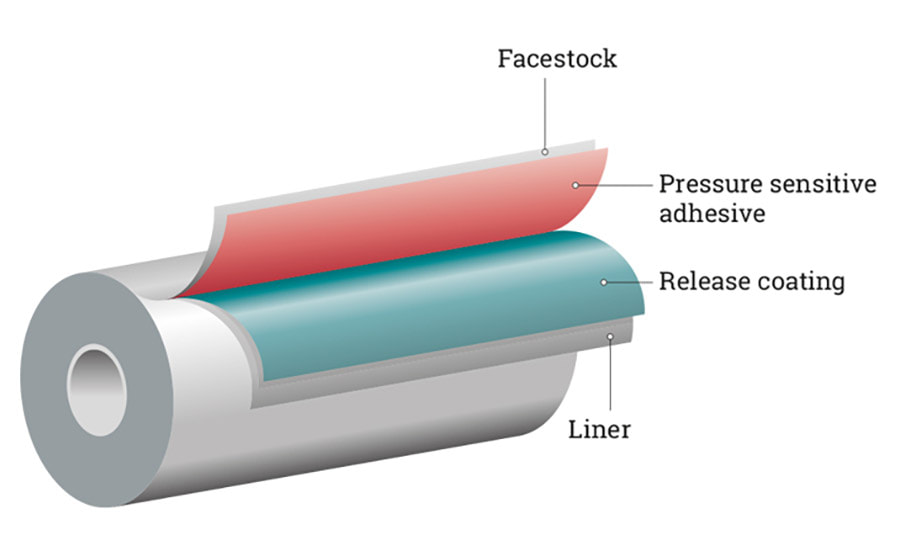
Because wetting is thermodynamically unfavorable, interfacial van der Waals attraction between the adhesive and the release coating remains minimal. Under peel stress, cleavage occurs precisely along the release-coating/adhesive interface (adhesive failure mode), leaving no adhesive residue on the liner and preserving the full tacky surface of the PSA for subsequent bonding. The force required for this separation — the peel release force — is governed by the siloxane chain length between crosslink points and the crosslink density of the cured network.
The same dimethacrylate PDMS macromer used to build this low-energy release surface is also the foundation of an entirely parallel class of radiation-cured materials: uv curable silicone crosslinkers for optical adhesives and inks, where its rapid photopolymerization kinetics are utilized for bulk bonding rather than release.
Where a mono-graft architecture is preferred over the difunctional dimethacrylate, our specification guide to methacrylate-terminated PDMS covers the molecular weight and viscosity windows that keep gelation under control.
A diol functional silicone can replace the acrylate cure for condensation systems.
2. Telechelic Dimethacrylate PDMS: The Cure Mechanism in UV Release Films
The cure chemistry itself is straightforward: methacryloxy groups at both chain ends undergo instantaneous free-radical addition polymerization under UV irradiation. When formulated with photoinitiators (such as acylphosphine oxides like TPO or bis-acylphosphine oxides like Omnirad 819) and exposed to 365 nm or 395 nm LED-UV sources, the C=C double bonds convert to a fully crosslinked three-dimensional network within 0.1 to 0.5 seconds on high-speed coating lines running at 100–300 m/min.
Coatings formulators use that same acrylate radical cure, and our overview of silicone acrylate grades shows how molecular weight and functionality shift viscosity, slip, and crosslink density.
This cure profile matters enormously for heat-sensitive film substrates — PET, PE, PP, and BOPP. Conventional platinum addition-cure systems require thermal ovens operating at 120–160°C to achieve acceptable line speeds. At those temperatures, thin polymer films stretch, wrinkle, and lose dimensional stability. Radiation-curable dimethacrylate PDMS cures at ambient substrate temperature, unlocking ultra-thin (12–23 μm) filmic release liners for electronics packaging and medical dressings that cannot tolerate thermal ovens.
Because release force requirements vary enormously across tape types, label constructions, and die-cutting processes, formulators frequently require release force control agents (CRAs) or customized polymer architectures to balance easy release against high-speed converting stability. For specialized molding, composite de-molding, and non-liner applications, synthesis of silicone based release agents provides tailored pathways spanning reactive siloxane structures, specialty emulsification, and hybrid release architectures.
3. Preventing Silicone Migration: Safeguarding Subsequent Adhesion Strength (SAS)
The most damaging failure mode in release liner manufacturing is silicone migration, sometimes called ghosting. If the release coating contains unbound silicone species — unreacted silicone oil, low-molecular-weight cyclics (D4, D5), or non-functional silicone fluid — those molecules diffuse across the interface into the adjacent PSA layer during storage. Once inside the adhesive matrix, the free silicone acts as an internal contaminant, permanently lowering the tack, shear strength, and peel adhesion of the adhesive tape or label. In industry testing (FINAT FTM 11), this is measured as Subsequent Adhesion Strength (SAS): a high-quality release liner must sustain SAS values above 90–95% compared to a virgin reference adhesive.
Dimethacrylate PDMS structurally prevents this outcome. Because both chain ends carry reactive methacrylate groups, conversion under adequate UV dose is near-complete, chemically locking virtually 100% of the siloxane chains into the crosslinked network. Unbound silicone extractables are suppressed to fractions of a percent, eliminating the silicone transfer that causes adhesive poisoning and ensuring consistent SAS values across extended storage periods.
A hydroxyalkyl functional silicone can end-cap the release polymer.
4. Formulation Guidelines: Crosslink Density, Release Modifiers, and Web Tension
Balancing release force and mechanical robustness requires attention to three core formulation parameters:
- Molecular Weight and Crosslink Density: Lower-MW dimethacrylate PDMS (1,000–3,000 g/mol) yields higher crosslink density, producing a firmer network with slightly higher release force but exceptional rub-off resistance. Higher-MW grades (5,000–15,000 g/mol) provide longer flexible siloxane loops between crosslink nodes, maximizing surface non-polarity and yielding ultra-easy release (peel forces below 5–15 g/25 mm at 300 mm/min).
- Controlled Release Agents (CRAs): For tight-release applications (such as die-cut label matrices that must not prematurely release during high-speed matrix stripping), multi-functional silicone resins (MQ resins or vinyl-functional silicate networks) are blended into the dimethacrylate base to incrementally increase peel force from easy (10 g/in) to medium (30–60 g/in) or tight (>100 g/in).
- Inert Atmosphere Processing: Because free-radical methacrylate polymerization is subject to atmospheric oxygen inhibition, UV release coating lines typically employ nitrogen-inerted curing chambers with oxygen concentrations maintained below 50–100 ppm. This ensures instantaneous, tack-free surface cure without unreacted monomer residues.
Controlling that balance begins at the macromer stage: end-capping a hydroxy- or hydride-terminated polydimethylsiloxane with a methacrylate-functional silane fixes crosslink density and cure speed before formulation starts. Our methacrylate macromer guide covers those synthesis routes and the molecular-weight windows they deliver.
5. Frequently Asked Questions (FAQs)
Q1: What is Subsequent Adhesion Strength (SAS) and why is it critical in silicone release liners?
Subsequent Adhesion Strength measures the percentage of adhesive tack retained by a pressure-sensitive adhesive after being laminated against a release liner and peeled off, compared to an adhesive that was never exposed to silicone. An SAS value >95% indicates virtually zero silicone migration, ensuring the tape or label adheres with full design strength when finally applied to the end substrate.
Q2: Why is dimethacrylate PDMS preferred over thermal platinum-cure silicones on plastic film liners?
Thermal platinum-catalyzed silicones require high oven temperatures (120–160°C) that cause thin film substrates (such as 12–23 μm PET, BOPP, and PE) to deform, stretch, or shrink. UV-curable dimethacrylate PDMS cures at ambient temperatures in fractions of a second, completely preserving the dimensional accuracy and mechanical integrity of delicate film liners.
Q3: How is release force adjusted from ‘easy’ to ‘tight’ in dimethacrylate release coatings?
Release force is tuned by varying the molecular weight of the dimethacrylate PDMS (higher MW yields easier release due to longer flexible siloxane loops) or by formulating with controlled release additives (CRAs), such as silicone MQ resins, which increase network stiffness and interfacial peel resistance to prevent premature pre-dispensing during high-speed matrix stripping.
Q4: Does UV-cured dimethacrylate silicone suffer from catalyst poisoning?
No. Unlike platinum-catalyzed addition systems — which are severely deactivated by residual amines, sulfur compounds, organotin stabilizers, or phosphorus on recycled paper or synthetic films — free-radical photopolymerization of methacrylates does not rely on precious-metal coordination complexes and is immune to platinum catalyst poisoning.
Q5: Why is nitrogen inerting necessary during the UV curing of methacrylate silicone release coatings?
Atmospheric oxygen quenches growing free radicals at the coating surface, forming unreactive peroxy radicals that halt polymerization. In release liners, incomplete surface cure leaves unreacted monomer that transfers to the adhesive. Maintaining an inert nitrogen atmosphere (oxygen <50–100 ppm) ensures instantaneous, 100% complete surface cure with zero extractable residues.
Beyond release liners, a UV curable silicone oligomer in the low-viscosity range also serves inkjet inks — see the dedicated guide.
The liner is one half of the system — pair it with a silicone PSA adhesive built on single-ended reactive PDMS, detailed in our dedicated guide.
