
High-end industrial coatings — automotive refinish, coil coatings, wood furniture lacquers, and photovoltaic backsheet films — face a persistent challenge during film formation: the trade-off between flawless surface leveling and durable mechanical slip. Formulators routinely battle orange peel, pinholes, and Bénard convection cells caused by uneven surface tension gradients as solvents flash off and curing begins. Adding conventional silicone fluids or polyether-modified polydimethylsiloxanes (PDMS) provides temporary leveling and slip — but at a steep cost: migration to the surface, blooming over time, loss of recoatability, and catastrophic contamination of downstream processing lines.
Reactive silicone leveling agent chemistry resolves this at the molecular level. Built on a mono-diol-functional reactive silicone oil backbone, these specialized additives migrate rapidly to the air-film interface to eliminate surface tension differentials, and then covalently react into the host resin matrix during cure. The result is a mirror-smooth finish, permanent surface slip, and long-term anti-blocking — with zero migration, zero blooming, and zero recoat adhesion failure.
1. The Physics of Surface Defects: Orange Peel, Cratering, and Bénard Cells
Understanding why reactive leveling works requires understanding what causes defects in the first place. During solvent evaporation and crosslinking exotherm, temperature and solvent concentration gradients develop across the wet film depth. Because solvent evaporates faster from thin regions than thick ones, localized areas develop higher surface tension than adjacent areas. This surface tension differential drives the Marangoni effect: liquid flows spontaneously from regions of low surface tension to regions of high surface tension, setting up circulating convection currents known as Bénard cells.
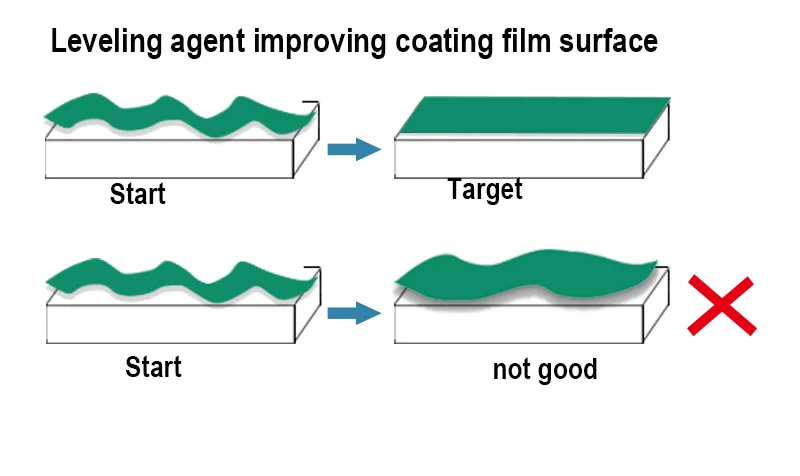
Those circulating cells are Bénard cell coating defect structures: organized convective vortices that manifest macroscopically as the characteristic dimpled texture called orange peel defect. Where foreign contaminants — airborne dust, oil droplets, or spray overspray — land on the wet film, local surface tension drops sharply, driving fluid outward and forming craters or fish eyes.
A reactive mono-diol PDMS leveling agent suppresses this by a two-step mechanism. First, the extremely low surface energy of the PDMS segment (~21 mN/m) drives rapid migration to the coating-air interface. Once at the surface, it establishes a uniform low-surface-tension boundary layer, equalizing surface tension differentials across the film and eliminating the Marangoni forces that drive convection cell formation. Second, by lowering overall surface tension rapidly, it promotes spontaneous substrate wetting and flow out, ensuring the wet film levels before viscosity rises beyond the point of mobility.
2. Reactive vs. Traditional Silicone Additives: The Zero-Migration Advantage
Conventional silicone leveling additives are physically dispersed within the cured coating matrix. They are not chemically bonded to anything. Under thermal load, weathering, or repeated solvent cleaning, these unbound silicone molecules migrate and bloom to the surface. The consequences are well-known to industrial coaters:
- Intercoat adhesion failure in multi-coat systems (the subsequent clearcoat or overprint delaminates).
- Contamination of post-processing operations (silicone transfer to embossing rollers, cutting dies, or adhesive tapes).
- Hazing and loss of gloss as free silicone forms an oily, dust-attracting surface film.
This is precisely the limitation that reactive mono-diol PDMS eliminates. The terminal diol group reacts during cure with hydroxyl-reactive crosslinkers present in the host system — aliphatic polyisocyanates in 2K polyurethane systems, melamine-formaldehyde resins in baked amino systems, or epoxide rings in epoxy coatings. Through this co-reaction, the PDMS segment becomes covalently anchored into the polymer backbone at the coating surface. Because it is chemically locked into the crosslinked network, it cannot migrate, bloom, extract into solvents, or transfer to process equipment.
This permanent slip additive mechanism also eliminates a common downstream problem in coil coating and printed packaging: silicone contamination of press rollers and slitting blades, which plagues formulations built on non-reactive silicone fluids.
The same reactive-versus-additive logic governs photocurable coatings: a UV-curable reactive diluent based on a silicone acrylate oligomer bonds into the network during cure instead of migrating out over time.
The diacrylate silicone backbone behind these surface-modifying additives is locked into the film the same way.
For applications where the silicone modification needs to extend through the full resin backbone — not just the surface additive level — the analogous approach using silicone modified polyester resin provides bulk-level weatherability and flexibility for pre-coated metal coils and exterior cladding.
3. Dual Functionality: Permanent Surface Slip and Long-Term Anti-Blocking
Beyond leveling, surface-enriched PDMS sidechains deliver two additional functional benefits that are particularly valuable in high-throughput coating operations: surface slip and anti-blocking performance.
As an anti blocking additive, the cured silicone surface layer dramatically reduces interfacial adhesion energy between stacked or wound coating surfaces. In roll-to-roll coil coating, painted metal coils are wound under tremendous tension immediately after baking. In sheet-fed wood finishing and carton printing, stacked boards and cartons exert continuous compressive loads on freshly cured finishes. Without effective anti-blocking, adjacent surfaces fuse, causing coating pick-off, tear defects, and scrap. Reactive mono-diol PDMS creates a durable, non-tacky surface shield that prevents blocking even under elevated winding temperatures (up to 80°C) and heavy stacking pressures.
Reactive additives only keep their benefit if the functional chain is chemically locked into the film; methacrylate-functional macromers achieve the same permanence through free-radical grafting rather than diol-isocyanate coupling. Our methacrylate-terminated PDMS guide details the synthesis routes and grade selection behind those UV-cured systems.
The same surface layer sustains a dynamic coefficient of friction (COF) consistently below 0.15 across the service life, providing the silky-slip tactile feel sought in automotive interior soft-touch coatings, consumer electronics housings, and premium packaging lacquers — all while surviving aggressive solvent rubs (such as MEK double rubs) without loss of performance.
For applications requiring ultra-low-friction nanocoating architectures or custom surface modification beyond standard formulation ranges, development of silane based surface modifiers provides application-tailored synthesis pathways spanning customized reactive functional groups, tailored siloxane chain lengths, and hybrid fluoro-silicone architectures.
Where acrylate cure is unavailable, a hydroxy terminated silicone offers condensation reactivity.
4. Formulation Guidelines: Dosage, Compatibility, and Recoatability
Recommended addition level is 0.1–1.0 wt% of total formulation. This narrow range reflects the high surface efficiency of PDMS — a nanoscale-thick enriched layer at the interface is sufficient to achieve both leveling and slip. Over-addition above 1.5 wt% yields no additional leveling benefit and can risk haze in high-polarity clearcoats.
Recotability of silicone coatings is the formulation parameter most sensitive to overloading. In a physically blended system, excess free silicone migrates to the interface and acts as a mold-release boundary, making recoating impossible without heavy sanding. With reactive mono-diol PDMS, recoatability is preserved because the additive is co-cured into the bulk: when a second coat is applied, the crosslinked surface presents reactive hydroxyl and urethane/amino groups that participate in crosslinking with the topcoat, maintaining robust intercoat adhesion.
Terminal-group choice tracks the cure chemistry: hydroxyl-functional PDMS suits isocyanate and melamine systems, while free-radical UV and peroxide routes call for a monofunctional PDMS macromer carrying a single methacrylate end-group.
5. Frequently Asked Questions (FAQs)
Q1: How does a reactive silicone leveling agent eliminate the orange peel defect in baked coatings?
During the early solvent-evaporation phase, the low-surface-energy PDMS segment concentrates at the coating-air boundary, creating a uniform surface tension across the wet film. This suppresses the Marangoni forces that drive Bénard cell convection currents, enabling the wet film to flow out into a mirror-flat profile before crosslinking locks the surface in place.
For low-shrinkage photopolymer formulas, a silicone acrylate oligomer can also deliver the same low surface energy and slip that a leveling agent provides.
Q2: What causes traditional silicone leveling additives to fail under solvent wipe testing?
Non-reactive silicone oils exist in the cured film only as physical mixtures held by weak van der Waals forces. When the surface is wiped with solvents (such as MEK or alcohol) or subjected to repeated washing, the unbound silicone is extracted, causing rapid loss of slip and water repellency. Reactive mono-diol PDMS is covalently bonded into the host network and cannot be washed away.
Where controlled surface migration is wanted, a monofunctional methacrylate PDMS offers a wider release-force window than a difunctional network.
A silicone polyol extends the chain while adding slip.
Q3: Will the reactive mono-diol PDMS leveling agent cause gelation in two-component PU coatings?
No. The mono-diol structure places both reactive hydroxyl groups on one end of the silicone chain, leaving the other end as an unreactive PDMS tail. As a result, it acts as a pendant graft onto the growing polymer chain rather than bridging two chains together. This eliminates the risk of premature gelation and viscosity buildup during mixing and application.
Q4: How does this additive prevent blocking in rolled coils and stacked painted panels?
Surface-enriched siloxane methyl groups have extremely low surface energy and minimal intermolecular adhesion with adjacent surfaces. When coated coils are wound under tension or painted boards are stacked, the silicone boundary prevents contact adhesion between opposing coating faces, completely stopping paint pick-off and blocking defects.
Q5: At what stage of coating manufacturing should the reactive leveling agent be incorporated?
It can be added during the letdown stage with low-shear mixing, or directly into Component A (polyol or acrylic resin side) in 2K formulations. Because of its mono-diol design, it exhibits good solubility in standard coating solvents (xylene, PMA, butyl acetate) and does not require high-shear dispersion.
The slip and anti-blocking function in energy-cured coatings is delivered by a UV inkjet ink oligomer in the jettable range — see the guide for viscosity windows.
