
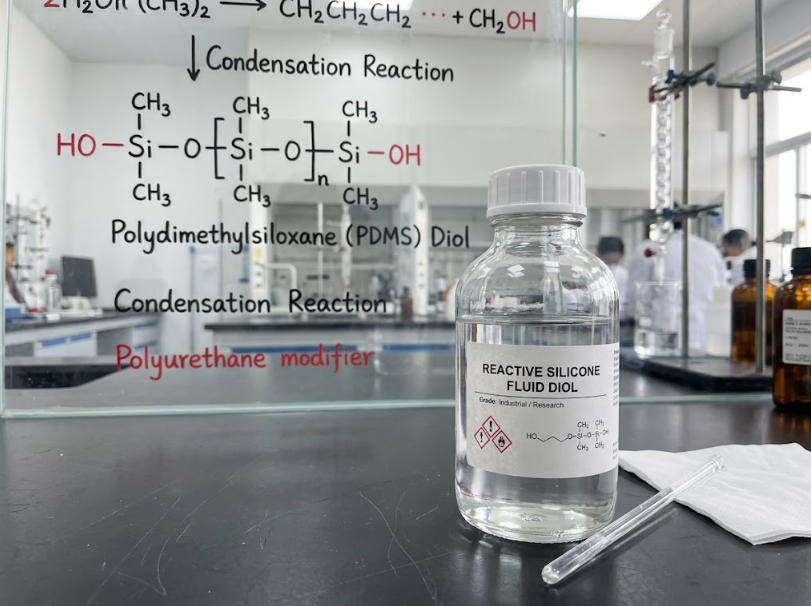
A reactive silicone fluid diol is a room-temperature liquid siloxane carrying hydroxyl (–OH) groups at the chain end or on side chains. Its viscosity typically stays below 1,000 cSt, so it flows freely under ambient conditions without any pre-treatment.
This liquid state separates it clearly from high-molecular-weight, solid, or waxy hydroxyl-terminated PDMS grades. Because the product is already pumpable, you can meter and inject it directly into a formulation. No heating, no solvent, and no pre-melting step are needed. That simplicity makes it well-suited for continuous-process compounding and precision-dosing systems where consistent stoichiometry matters.
How the Diol Functionality Drives Reactivity
The –OH groups on a reactive silicone fluid diol react with isocyanates, carboxylic acids, and anhydrides. This chemistry grafts the siloxane backbone directly into PU soft segments, polyester chains, or crosslinked coating networks.

Because it co-reacts with the matrix, it does not volatilize the way a conventional solvent does. You gain lower processing viscosity without sacrificing performance in the cured product. The siloxane segment stays locked in the network and continues to deliver silicone softness, low surface energy, and UV stability over the product’s service life.
Fluid Form vs. Solid/Waxy Silicone Diols
The table below compares the fluid diol with higher-MW, solid hydroxyl-terminated PDMS on the processing factors that matter most in formulation work.
| Feature | Reactive Silicone Fluid Diol | Solid / Waxy PDMS |
|---|---|---|
| Room-temp state | Liquid, free-flowing | Solid or waxy |
| Viscosity | Below 1,000 cSt | High, rises with MW |
| Metering and pumping | Pumpable, injectable | Needs heat or solvent |
| Formulation role | Reactive diluent / co-reactant | Bulk resin / modifier |
| Process fit | Continuous, low-temperature mixing | Pre-melt or dissolve first |
Choosing the fluid form simplifies equipment design. Standard pumps, flow meters, and static mixers handle it without heat-tracing or jacketed tanks.
Key Roles in Formulation
Reducing system viscosity. The low-viscosity fluid thins high-viscosity resins and cuts mixing energy. This benefit shows up most clearly in casting, RIM, and spray applications where flow control is critical.
Improving processability. Pumpable liquids fit continuous-metering lines far better than solids do. Accurate shot weights and repeatable stoichiometry follow directly from precise volumetric dosing.
Delivering silicone properties. Once it reacts into the polymer network, the siloxane segment contributes flexibility, weatherability, and a low-energy surface. The finished part gains a smooth, non-stick, UV-stable character without any post-treatment. Broader building blocks that pair with these fluids are grouped in our silane products catalog.
Applications of Reactive Silicone Fluid Diol
Polyurethane soft segments. Formulators use reactive silicone fluid diol as a co-polyol alongside conventional polyols. The siloxane segment increases flexibility and elastic recovery while also improving hydrophobicity and thermal stability. The same PU soft-segment chemistry is used in silane modified polyurethane systems.
Polyester modification. In co-condensation reactions, the diol co-reacts into polyester backbones. This shifts the hydrophilic–hydrophobic balance and improves outdoor durability, making the resulting resin useful in exterior coatings and films. For the related solid, higher-MW grades, see our guide to hydroxyl terminated PDMS.
Coatings and resin systems. As a reactive diluent, it reduces application viscosity and lowers VOC content. After cure, the silicone content stays chemically bound in the network, so it does not migrate or bloom to the surface over time. For the full family of reactive siloxanes, see our reactive silicone oil guide.
Anionic synthesis routes pair well with potassium trimethylsilanolate, an initiator for ring-opening siloxane chemistry. Background on how these chains are built appears in our article on siloxane polymer synthesis.
Frequently Asked Questions (FAQs)
Q1: What is a reactive silicone fluid diol?
It is a room-temperature liquid, low-viscosity siloxane with hydroxyl (–OH) groups at the chain end or on side chains. It acts as a flowable co-reactant or reactive diluent in PU, polyester, and coating formulations.
Q2: How is it different from solid hydroxyl-terminated PDMS?
It stays liquid at room temperature (typically below 1,000 cSt), unlike solid or waxy high-MW grades. You can therefore pump, inject, and meter it directly without heating or dissolving it first.
Q3: What does the diol group react with?
The –OH groups react with isocyanates, carboxylic acids, and anhydrides, grafting the siloxane into PU soft segments, polyester backbones, or crosslinked networks.
Q4: Why use it as a reactive diluent?
It lowers system viscosity during processing and, because it reacts into the final network, it does not evaporate like a non-reactive solvent. VOC levels stay low and the full silicone contribution is retained in the cured product.
Q5: What properties does it add to the cured material?
Silicone softness, weatherability, and low surface energy, giving the finished part a smooth, non-stick, UV-stable surface.
