
Microfluidics, the science of manipulating fluids at the micro-scale, has opened doors to revolutionary advancements in fields ranging from diagnostics and drug delivery to chemical synthesis. The success of these tiny “labs-on-a-chip” hinges on the materials used to construct them. While early devices utilized glass and silicon, the development of silicone materials for microfluidic devices has truly propelled the field forward, offering unparalleled flexibility, biocompatibility, and ease of fabrication. These materials, particularly elastomers like polydimethylsiloxane (PDMS), have become the gold standard, enabling rapid prototyping and the creation of complex, multi-layered systems that were once unimaginable.
This article explores the critical role of silicone materials in the microfluidics landscape. We will examine the key properties that make them ideal for this application, discuss various fabrication techniques, and highlight emerging trends and innovations in material science that continue to shape the future of microfluidic technology.
PDMS Microfluidic Devices
Polydimethylsiloxane (PDMS) dominates as the silicone elastomer of choice in microfluidics. Researchers widely adopt it because its unique combination of properties suits the creation of intricate and functional microfluidic systems. PDMS is a transparent, non-toxic, and gas-permeable polymer, which makes it ideal for biological applications, such as cell culture and analysis, where oxygen and carbon dioxide exchange is essential.
One of the primary advantages of PDMS is its low surface energy, which prevents many substances from sticking to the channel walls, ensuring smooth fluid flow. Its elasticity is another key feature. This property allows for the integration of pneumatic valves directly into the chip architecture—a technique known as multilayer soft lithography. By applying pressure to overlying channels, the flexible PDMS membrane can deflect and close off a fluid channel below it, creating micro-valves and pumps with no moving parts. This has been a game-changer for automating complex processes on a single device. Furthermore, its optical transparency across a wide spectrum allows for various on-chip detection methods, including fluorescence microscopy.
Microfluidic Channels Fabrication
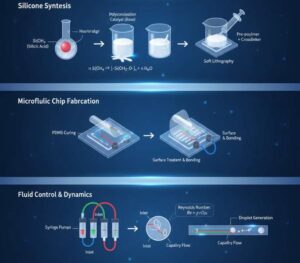
The fabrication process is central to creating functional microfluidic devices. For silicones like PDMS, the most common technique is soft lithography, specifically replica molding. This multi-step process offers a cost-effective and rapid way to produce high-fidelity microstructures.
- Master Mold Creation: The process begins with the creation of a master mold, which is a positive replica of the desired microchannel design. This mold is typically fabricated using photolithography, where a UV-sensitive material called a photoresist is spun onto a silicon wafer and selectively exposed to UV light through a photomask. The exposed or unexposed photoresist is then washed away, leaving a patterned, high-resolution master.
- Replica Molding with Silicone: Next, a liquid prepolymer of the silicone elastomer, often a two-part system consisting of a base and a curing agent, is mixed. This mixture is poured over the master mold. The prepolymer must have low viscosity to flow into and fill the smallest features of the mold without trapping air bubbles. A vacuum chamber is often used at this stage to degas the mixture thoroughly.
- Curing: The mold, now covered with liquid silicone, is placed in an oven to cure. Curing solidifies the liquid into a flexible, solid elastomer. The curing time and temperature can be adjusted to control the material’s final mechanical properties.
- Demolding and Bonding: Once cured, the solid silicone layer is carefully peeled off the master mold. It now contains a negative replica of the mold’s features—a network of microchannels. To create enclosed channels, researchers permanently bond this PDMS slab to a flat substrate, which can be another PDMS piece or a glass slide. They typically use plasma oxidation to treat the surfaces, activating them to form strong, irreversible covalent bonds upon contact.
This process allows for the rapid prototyping of new designs and the mass production of identical devices, making the development of silicone materials for microfluidic devices highly scalable.
Silicone Rubber for Microfluidics
While PDMS is the most popular choice, it is not the only silicone material used in microfluidics. Different applications may demand specific properties, leading researchers to explore other types of silicone rubber for microfluidics. The choice of material often involves a trade-off between various characteristics like hardness, chemical resistance, and cost. For instance, some applications may require materials with greater rigidity or enhanced resistance to certain organic solvents.
Let’s compare some common silicone materials used in this field:
| Material Property | Polydimethylsiloxane (PDMS) | Fluorosilicone | RTV (Room Temperature Vulcanizing) Silicone |
| Primary Advantage | Optical clarity, gas permeability, elasticity, ease of use. | Superior resistance to non-polar solvents, oils, and fuels. | Cures at room temperature, good for sealing and simple molding. |
| Fabrication | Soft lithography (replica molding). Requires heat for curing. | Similar to PDMS, though curing parameters may differ. | Can be poured and cured without an oven, simplifying the process. |
| Solvent Resistance | Poor; swells in the presence of many organic solvents. | Excellent; maintains integrity with a wide range of chemicals. | Moderate; better than PDMS but not as robust as fluorosilicone. |
| Biocompatibility | Generally high, widely used for cell-based assays. | Good, but less studied for long-term cell culture than PDMS. | Varies by formulation; some may leach unreacted components. |
| Cost | Relatively low, readily available from multiple suppliers. | Higher cost due to specialized fluorine chemistry. | Generally low to moderate, depending on the grade. |
| Gas Permeability | High, ideal for cell culture applications. | Lower than PDMS. | Lower than PDMS. |
| Ideal Application | General-purpose microfluidics, cell biology, organ-on-a-chip. | Applications involving organic solvents, oil-in-water emulsions. | Prototyping, device sealing, applications not requiring high precision. |
The selection process is critical. A researcher developing a device for organic synthesis would likely benefit from fluorosilicone’s chemical resistance, whereas another focused on lung-on-a-chip models would prioritize the high gas permeability of PDMS.
Silicone Formulations and Precursors Innovations
The field of microfluidics is constantly evolving, and so are the materials that enable it. Researchers are actively working on developing new silicone formulations to overcome the limitations of standard PDMS. Key areas of innovation include modifying surface properties and tuning mechanical characteristics.
One major drawback of native PDMS is its hydrophobicity (water-repelling nature), which can cause issues with bubble formation and inconsistent flow in aqueous applications. To address this, scientists employ surface modification techniques or incorporate additives into the bulk material to make it more hydrophilic.
Another area of active development involves tuning the mechanical properties. You can precisely control the stiffness (Young’s modulus) of silicone by adjusting the base-to-curing-agent ratio or incorporating different cross-linking molecules. This control is crucial for applications requiring specific mechanical responses, such as mechanobiology studies where cells experience physical strain.
The synthesis of these advanced silicones often relies on high-purity precursors like silanes and siloxanes. For example, trimethoxysilane and related compounds can be used as building blocks or surface modifiers to create silicones with tailored functionalities. These functional silanes can introduce specific chemical groups onto the polymer backbone or surface, enabling properties like improved biocompatibility, controlled drug release, or covalent attachment of biomolecules. The continued innovation in silane chemistry is directly fueling the advancement of next-generation microfluidic devices with enhanced capabilities.
