
Corrosion is a relentless natural process that costs the global economy trillions of dollars each year, compromising the safety and integrity of everything from public infrastructure to industrial machinery. For decades, the primary defense against rust and degradation has been heavy-metal-based inhibitors and toxic organic compounds. However, as environmental regulations tighten and industries seek more sustainable solutions, the focus has shifted. The development of silane-based corrosion inhibitors represents a significant technological advancement, offering an eco-friendly and highly effective alternative for protecting metallic surfaces.
These innovative inhibitors leverage the unique chemistry of silanes—molecules containing silicon—to form a durable, water-repellent barrier directly on the metal substrate. This protective film not only physically blocks corrosive elements like water and salt but also chemically bonds to the surface, creating a long-lasting defense. This approach moves beyond temporary coatings to provide an integrated layer of protection that is both resilient and environmentally responsible.
How Silane-Based Corrosion Inhibitors Work
The effectiveness of silane inhibitors lies in their dual-functionality molecular structure. A typical organofunctional silane molecule has two distinct ends:
- Hydrolyzable Groups: One end of the molecule contains reactive groups, commonly alkoxy groups like methoxy (-OCH₃) or ethoxy (-OC₂H₅). When exposed to water (even trace amounts of moisture in the air), these groups hydrolyze to form reactive silanol groups (Si-OH).
- Organofunctional Groups: The other end features an organic functional group (-R) that is chosen for its compatibility with a subsequent coating or for its own inherent properties, such as hydrophobicity.
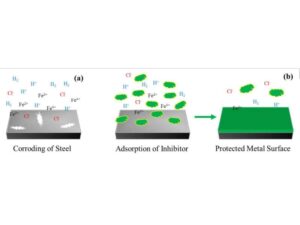
The corrosion inhibition process occurs in a few key steps. First, the silane solution is applied to the metal surface. The hydrolyzable groups react with water to form silanols. These silanols then bond with hydroxyl groups present on the metal’s surface (e.g., Fe-OH, Al-OH), forming strong, covalent metallo-siloxane bonds (e.g., Fe-O-Si).
Simultaneously, adjacent silanol groups react with each other in a condensation reaction, forming a highly cross-linked, stable siloxane network (Si-O-Si). This process creates a dense, thin, and water-repellent film that is chemically grafted onto the metal. The resulting barrier is typically only a few nanometers thick, yet it provides exceptional protection by preventing corrosive electrolytes from reaching the metal surface.
Silane-Based Corrosion Inhibitors
Initial research into silane treatments focused on their role as adhesion promoters between inorganic surfaces and organic coatings. However, scientists soon discovered their standalone potential for corrosion protection. The ongoing development of silane-based corrosion inhibitors has led to more sophisticated and specialized formulations.
Functionalization for Enhanced Performance
Early silane films, while effective, sometimes had limitations in terms of long-term durability or compatibility with certain topcoats. Modern development focuses on modifying the organofunctional group (-R) to add specific properties. For example:
- Amino-functional silanes, such as aminopropyltriethoxysilane (APTES), have shown exceptional performance on steel and aluminum. The amino group can chelate with metal ions on the surface, further strengthening the bond and providing an additional layer of inhibition.
- Epoxy-functional silanes are used to create films that have excellent adhesion to subsequent epoxy-based paints, creating a seamless and robust multi-layer protection system.
- Vinyl or Acrylate functional silanes can be used to prepare UV-curable protective layers. Silanes like Triisopropylsilyl Acrylate serve as precursors for such advanced coating systems.
Nanoparticles Incorporation
A groundbreaking area of development is the creation of composite silane films doped with nanoparticles. These “smart” coatings can offer active corrosion protection. Formulators disperse nanoparticles such as zinc oxide (ZnO), cerium oxide (CeO₂), or titanium dioxide (TiO₂) within the silane solution. If the protective film becomes scratched or damaged, these nanoparticles act as secondary inhibitors, passivating the exposed metal and effectively ‘healing’ the breach. This self-healing capability dramatically extends the service life of the protective coating.
Water-Based and Eco-Friendly Formulations
A major driver for silane development is the need to replace hazardous chromate-based conversion coatings. Silanes are an excellent alternative as they are free of heavy metals. Researchers currently focus on creating stable, water-based silane solutions that minimize or eliminate the use of volatile organic compounds (VOCs), making them safer for workers and the environment.
Silane Inhibitors vs. Traditional Corrosion Protection
Silane-based treatments offer a paradigm shift from traditional corrosion inhibitors. While methods like chromate conversion coatings have been effective, their toxicity poses significant health and environmental risks. Organic inhibitors, on the other hand, can be less durable.
| Feature | Silane-Based Inhibitors | Chromate Conversion Coatings | Traditional Organic Inhibitors |
| Protection Mechanism | Covalent bonding and formation of a dense, cross-linked barrier film. | Formation of a complex chromium oxide layer that passivates the metal. | Adsorption of inhibitor molecules onto the metal surface to block reactions. |
| Environmental Impact | Eco-friendly; free of heavy metals and low in VOCs. | Highly toxic and carcinogenic; strict regulations on use and disposal. | Varies; some are toxic and may have environmental persistence. |
| Film Thickness | Very thin (nanometer scale). | Thin (micrometer scale). | Variable; often requires thicker layers for effectiveness. |
| Adhesion | Excellent; forms covalent bonds with both the metal and subsequent coatings. | Good adhesion for paints. | Adhesion can be weak and reliant on physical forces. |
| Durability | High; chemically bonded to the substrate. | High, but susceptible to scratching. | Moderate; can be washed away or degrade over time. |
| Application Process | Simple dip, spray, or brush application at room temperature. | Multi-step process, often requiring specific pH and temperature control. | Often added as an additive to a coating or fluid. |
The move towards the development of silane-based corrosion inhibitors is a clear response to the need for a solution that balances high performance with environmental responsibility. The ability to create a strong, durable bond with the metal makes it a superior pre-treatment for painting and powder coating, ensuring that the final protective system has a much longer lifespan. Chemical precursors like 1,1,3,3-Tetramethyl-1,3-divinyldisilazane play a crucial role in creating the specialized polymers needed for these advanced systems.
Industries and Applications
The versatility of silane corrosion inhibitors makes them suitable for a wide range of industries and applications:
- Automotive: Used as a pre-treatment for car bodies and wheels before painting, significantly improving paint adhesion and preventing rust, especially in areas exposed to road salt.
- Aerospace: Applied to aluminum alloys to protect against corrosion in aggressive environments, replacing toxic chromate coatings while maintaining high performance.
- Construction: Used to protect steel rebar in reinforced concrete from chloride-induced corrosion, extending the life of bridges, buildings, and marine structures.
- Marine: Provides protection for ship hulls, offshore platforms, and other equipment exposed to saltwater spray and high humidity.
- Electronics: Can be used to form ultra-thin, transparent protective layers on circuit boards and connectors to prevent moisture-induced failure.
The continuous innovation in silane chemistry, including the use of specialized molecules like Trimethoxysilane as building blocks, ensures that these inhibitors will find even more applications in the future. As technology advances, the ability to tailor a protective film at the molecular level will be crucial for protecting the next generation of materials and devices.
Frequently Asked Questions
- Are silane-based coatings environmentally friendly?
Yes, they are considered a leading eco-friendly alternative to traditional methods. Manufacturers formulate them without toxic heavy metals such as hexavalent chromium and can produce them as water-based solutions with low or zero volatile organic compounds (VOCs). - How long does silane corrosion protection last?
The protection is very durable because the silane film is chemically bonded to the metal surface. Its lifespan is significantly longer than many traditional organic inhibitors and is comparable to or exceeds that of older, more toxic treatments. - Can silane coatings be applied on-site?
Yes, the application process is very flexible. Operators can easily apply silane solutions by dipping, spraying, or brushing at room temperature, making them suitable for both factory and on-site repair or maintenance applications - Is a silane treatment a replacement for paint?
Not usually. A silane treatment is primarily a pre-treatment or primer. It forms an ultra-thin protective layer that enhances corrosion resistance and provides an ideal surface for a topcoat like paint or powder coating to adhere to, creating a complete and robust system. - On what metals can silane inhibitors be used?
Silane inhibitors are effective on a wide variety of metals, including steel, aluminum, magnesium, zinc, and copper alloys. Formulators can optimize the specific silane formulation for maximum performance on a particular metal substrate.
