
As global energy demands continue to rise, the oil and gas industry faces the critical challenge of extracting hydrocarbons from increasingly complex and mature reservoirs. Traditional primary and secondary recovery methods often leave a significant portion of oil trapped within the porous rock formations. This has led to a surge in interest regarding chemical Enhanced Oil Recovery (EOR) techniques. Among the most promising innovations in this field is the development and application of custom silane compounds for enhanced oil recovery. These tailored chemical agents offer a sophisticated approach to modifying reservoir conditions, allowing operators to mobilize trapped oil that was previously considered unrecoverable.
Chemical EOR
Enhanced Oil Recovery represents the third stage of hydrocarbon production, typically deployed when the natural pressure of a reservoir has depleted and waterflooding has reached its economic limit. Historically, chemical EOR has relied heavily on polymers, surfactants, and alkalis. While effective in certain scenarios, these conventional chemicals often struggle in harsh reservoir environments. High temperatures, extreme salinity, and complex mineralogies can degrade polymers and cause surfactants to precipitate, rendering them ineffective.
This limitation has driven the scientific community to look beyond standard off-the-shelf chemicals. The industry is moving toward “smart” fluids—chemicals designed at the molecular level to withstand specific downhole conditions. This is where silane chemistry becomes invaluable. Unlike organic polymers which may break down under thermal stress, the silicon-oxygen backbone of silane compounds provides exceptional thermal and chemical stability. This durability ensures that the chemical agents remain active deep within the reservoir, far from the injection wellbore.
Designing Custom Silane Compounds for Enhanced Oil Recovery
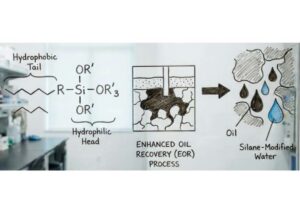
The true strength of silane chemistry lies in its versatility. Manufacturers can synthesize custom silane compounds for enhanced oil recovery by manipulating the functional groups attached to the silicon atom. A silane molecule generally consists of two distinct types of reactive groups: a hydrolyzable group (typically alkoxy) that bonds to the rock surface, and an organofunctional group that interacts with the oil or alters the fluid properties.
By adjusting the length and structure of the organic chain, chemists can precisely control the hydrophobicity (water-repelling) or hydrophilicity (water-attracting) of the rock surface. For instance, creating a compound using precursors like Trimethoxysilane allows for the formation of a durable monolayer on silica-based rocks like sandstone. If the reservoir requires a specific organic interaction, the synthesis might involve intermediates such as Triisopropylsilane, which offers steric bulk and unique solubility profiles.
This customization process is critical because no two reservoirs are identical. A carbonate reservoir with high calcium content requires a different chemical approach than a quartz-rich sandstone reservoir. Custom silane compounds for enhanced oil recovery can be synthesized to target specific mineralogies, ensuring that the chemical bonds effectively to the pore walls rather than being lost to adsorption in the wrong areas.
Wettability and Interfacial Tension
The primary mechanism by which silanes enhance oil recovery is wettability alteration. In many mature reservoirs, the rock surface is oil-wet, meaning the oil adheres strongly to the rock, making it difficult for water to displace it. The goal of EOR is often to shift this wettability toward a water-wet state, where water spreads over the rock surface and displaces the oil.
Silane nanofluids and solutions can penetrate the microscopic pores of the reservoir rock. Once inside, the hydrolyzable groups react with the hydroxyl groups on the rock surface, forming a covalent bond. This permanent modification changes the surface energy of the rock. If the goal is to make the rock more water-wet, hydrophilic silane variants are employed. Conversely, in gas condensate reservoirs, altering the rock to neutral wettability can prevent liquid blockage.
Furthermore, these compounds can help reduce the Interfacial Tension (IFT) between the oil and the displacing fluid. A lower IFT reduces the capillary forces holding the oil in place, allowing it to flow more freely through the pore network. Advanced synthesis techniques may utilize complex structures, such as those derived from 1,3-Dichloro-1,1,3,3-tetraisopropyldisiloxane, to create highly specialized surfactants that are effective even at very low concentrations.
Advantages of Custom Silane Compounds for Enhanced Oil Recovery
When compared to traditional surfactants and polymers, custom silane compounds for enhanced oil recovery offer several distinct advantages that translate directly to operational efficiency and cost savings.
- Thermal Stability:
Many reservoirs operate at temperatures exceeding 100°C (212°F). Standard polymers often undergo hydrolysis or shear degradation at these temperatures, losing their viscosity and sweep efficiency. Silanes, due to the strength of the Si-O bond, maintain their structural integrity in high-heat environments, ensuring consistent performance. - Tolerance to Salinity:
High salinity, particularly the presence of divalent cations like calcium and magnesium, is the enemy of traditional anionic surfactants. These ions can cause surfactants to precipitate out of the solution. Silane-based non-ionic or zwitterionic compounds are generally more robust in high-salinity brines, making them suitable for offshore reservoirs where seawater is used for injection. - Deep Penetration:
Because silane monomers are small molecules before they react with the rock surface, they can penetrate into tight formations with low permeability that large polymer chains cannot access. This allows for the treatment of micropores where significant oil reserves often remain trapped. - Permanence:
Unlike surfactants that can wash away, silanes form a covalent bond with the substrate. This means the wettability alteration is often permanent, providing long-term benefits even after the initial chemical slug has passed.
Improving Oil Recovery Efficiency
To understand the value proposition of these advanced materials, it is helpful to compare their efficiency against standard recovery methods. The table below illustrates the comparative advantages of using custom silane compounds for enhanced oil recovery versus conventional waterflooding and standard surfactant flooding.
| Feature / Metric | Conventional Waterflooding | Standard Surfactant Flooding | Silane-Based EOR |
| Recovery Factor Increase | Baseline | 5% – 15% | 15% – 25% |
| Thermal Stability Limit | N/A | ~80°C – 100°C | > 150°C |
| Salinity Tolerance | High | Low to Moderate | High |
| Mechanism | Physical Displacement | IFT Reduction | Wettability Alteration & IFT Reduction |
| Durability of Effect | Temporary | Temporary (washout risk) | Permanent (Chemical Bond) |
| Pore Penetration | Limited in tight rock | Moderate | Excellent (Micro-pore access) |
| Adsorption Loss | N/A | High | Low (Targeted bonding) |
Key Precursors in Silane Synthesis
The successful deployment of these EOR fluids starts in the chemical manufacturing plant. High-purity precursors are essential for synthesizing compounds that perform reliably downhole. Chemical suppliers provide the building blocks that EOR service companies use to formulate their proprietary blends.
For example, Chloromethyltrimethylsilane is a versatile intermediate used in introducing specific alkyl groups to the silane structure. It serves as a fundamental unit for building more complex organosilanes that balance solubility with reactivity. You can explore this precursor here: Chloromethyltrimethylsilane.
Similarly, Triisopropylchlorosilane provides a bulky steric group that can protect the siloxane bond from premature hydrolysis, a critical feature for chemicals that must survive the long transit time from the injection well to the target zone deep in the reservoir. This product is available for specialized synthesis needs: Triisopropylchlorosilane.
For researchers and formulators looking to create novel cross-linked structures or modify surface rheology, compounds with reactive vinyl groups or specialized leaving groups are necessary. Products like 1,4-Dichloro-2-butyne can be utilized in multi-step synthesis to create unique bridging groups within a silane network, enhancing the mechanical strength of the chemical agents.
Implementation Strategies
Implementing custom silane compounds for enhanced oil recovery requires a comprehensive reservoir analysis. The process typically begins with core flooding experiments in the laboratory. Geologists and chemists analyze reservoir rock samples to determine their mineral composition and current wettability state. Based on this data, a custom silane formulation is synthesized.
If the reservoir is a sandstone formation with high clay content, the silane must be designed to minimize interaction with the clay swelling while maximizing the coating of quartz grains. Once the optimal molecule is synthesized, it is tested for compatibility with the injection brine to ensure no unwanted precipitation occurs.
Field pilots follow successful lab tests. During a pilot, a small quantity of the silane fluid is injected into a single well or a confined pattern of wells. Engineers monitor injection pressures and production rates from offset wells to verify the chemical’s effectiveness. Because silanes can permanently alter rock properties, these pilots are crucial for fine-tuning the concentration and slug size before full-field implementation.
The future of EOR lies in this level of customization. As easily accessible oil reserves dwindle, the ability to chemically engineer the reservoir environment using sophisticated tools like silane compounds will become not just an advantage, but a necessity for efficient resource management.
Frequently Asked Questions
- How do custom silane compounds improve oil recovery compared to waterflooding?
They alter the rock’s wettability (e.g., from oil-wet to water-wet) and reduce interfacial tension. This releases oil trapped in pores that waterflooding alone cannot displace, significantly increasing the mobile oil fraction. - Are silane-based EOR chemicals safe for the environment?
Silane compounds are generally stable and can be designed to be low-toxicity. Because they bond chemically to the rock deep underground, the risk of them migrating into shallow aquifers is minimized compared to some water-soluble surfactants. - Can silane compounds be used in high-temperature reservoirs?
Yes, this is one of their primary benefits. Silanes possess a silicon-oxygen backbone that is highly thermally stable, allowing them to remain effective in reservoirs with temperatures exceeding 150°C, where traditional polymers would degrade. - Is it expensive to use custom silane compounds for EOR?
While the upfront cost of the chemical is higher than water, the increased recovery factor and extended production life of the well often result in a lower cost per barrel of incremental oil produced, offering a high return on investment. - How are these compounds applied to the reservoir?
They are typically injected as a dilute solution or nanofluid dispersion into the injection well. The fluid travels through the reservoir, coating the rock surface and mobilizing oil, which is then produced at the extraction wells.
